/People talking without speaking/ /People hearing without listening/
The Art of Silence,
When I was in Yeshiva I made it a point to ask every Rabbi what Gehenim (Ashikanizisized Gehenna, no relation go Gena) was like. The concept of hell is much more clearly defined by the Christians than the Jews. Christians devoted enormous energy to the the articulations of the architecture, leadership, bureaucracy, administration of and qualifications by which one would enter hell. The book of Revelations gave us hell’s CEO and administrative commission, Dante walked us through its various offices and departments while Jheronimus Bosch gave us a detailed illustrative map of the activities within.
Jews on the other hand don’t have a very well defined articulation of Gehenim. There are a no mentions of it in the Old Testament and while there are references in some tractates of the talmud and other sources, by and large, hell is an abstraction merely referenced but never fully explored.
As a young yeshiva talmud (student) I was often curious about the wages of sin. Of the 613 commandments in the old testament, 365 are negative (as in “DO NOT”) the rest positive, (as in “DO THIS”.) They range from sublimely prophetic of my later experimentation with N,N-Dimethyltryptamine , “Do not go into trances to see the future” (Deut 18:10 ) to the banal “Do not eat fruit found on the ground”, ( Lev 11:42) which my children break every apple picking season . I was alway curious of what happens post mortem if you break the commandments.
In some cases god is very prescriptive in the Bible. Eating bread on Passover will have your “soul cut off from Israel”, while any number of sexual and “moral” improprieties will have you stoned, beaten, thrown off a cliff or burned with molten lead. In other cases there is the clear prohibition or instruction but not a corresponding consequence for the violation thereof. Add to this a trillion and a half rabbinical statutes to which an Orthodox Jew must adhere, all of them carrying the risk of sin, and according to tradition, are as binding as the word of god himself. These rabbinical prohibitions and laws ranging from eating chicken and milk together to women covering their hair, are indeed sins. Extremely grave ones if you are in the orthodox part of the Tribe. Surely then, if one breaks such laws some punishment is met out when the mortal coil is finally shuffled off un-atoned.
Being a curious and precocious yeshiva boy, it was very natural to ask my rabbis “what happens when I die if I sin in life?” The answer would vary according to age and Rabbi. Responses ranged from the generic “ god will punish you” without the asked for specificity to the almost Christian “ you’ll burn in hell.” There were, however, two answers which actually resonated with me.
The first was told to me by Rabbi Nate Segal in 9th grade. Rabbi Segal was not a my Rabbi but rather a young rabbinical student who was a leader in NCSY ( National Congress of Synagogue Youth, an orthodox youth organization which tried to expose Jewish teens to American Orthodox Judaism). He was instrumental in helping me shape my Jewish identity. He was an incredibly charismatic man who coached our high school basketball team. He exposed me to new ideas and treated me with respect, something sorely needed in my life. More importantly he used to listen to Howard Stern in the car. That made me my hero, a religious Jew who had a sense of humor which echoed my own. More on him at a different time.
When I asked him about Gehenim he told me the allegory of the long spoons. Attributed to Rabbi Chaim of Romshishok, the parable describes hell as a group of people seated at a banquet table filled with every conceivable nourishing delight. Each person at the table is outfitted with a elongated spoon(or fork or chopstick) too long to feed themselves. In hell, it is said, people are so selfish that they cannot/will not cooperate to feed each and thus starve.
This struck me as more of an indictment of man than the infallible justice of an omipotent god. Certainly this would apply to people who’s sins are those of selfishness. But it really did not explain why this punishment would be justified for those who’s sins are strictly between themselves and the almighty. Surely if you ate shellfish it did not mean that in the after life you would suffer by acting selfish.
The second explanation was given to me by Rabbi David Riess. My teacher, mentor and father figure. (Much, Much Much more on Rabbi Riess at a different time. ) When I asked him what Gehenim was like, his answer made all the sense in the world to me. What he said was palpable, real. It was a hell that I had experienced first hand. A hell expertly weaponized by virtually every member of my family against each other and against the world. There were no pitch forks or devils, no fires or elongated utensils. This was a real hell I knew.
“Gehennim is the absence of god. His silence when you need him the most. You see, when you die the first thing that you see is how beautiful and incredible god is. How being in his Schina ( presence ) is in itself the reward for all your hard toil of keeping his laws and suffering on earth. Peace fills you. His voice fills your heart with unbelievable joy. Once you see and hear god’s presence you will want to be in it for eternity. Just then, as soon as you know the beauty of god, you are judged and your sins are weighed. And the punishment for your sins is that the Schina goes away and god stops speaking to you. The pain of having something that incredible taken away from you is hell.”
There were two primary modes of communication in my childhood home, silence and screaming. Neither one actually communicated anything but were ever present.
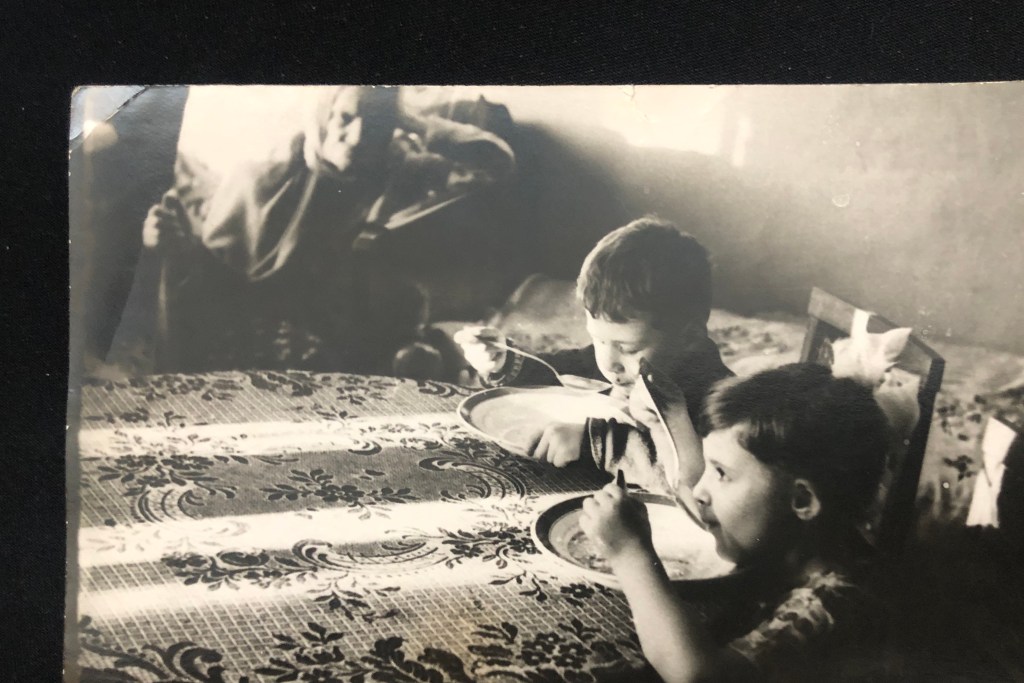
The 7 of us lived in a small apartment in Kiev, small by US standards, lap of luxury by those of Soviet Russia . The Ortenberg clan were my parents, Aron and Sima, my older sister Maya and my two grand mothers, Feige (paternal), Genya (maternal) plus Asta, a stunning jet black Alsatian.
Space, even in the new construction at Kharkiv’ky Shosse 16, was at a premium. My maternal grandmother shared a room with my sister, seven years my senior, while I shared the living room/bedroom with my parents. Grandma Feige had her own room.
To my memory, there was never discussion about why I did not share Grandma Feige’s room. Her domain was exclusively hers and while I had no say in where I slept, I could not be happier not to have slept in her room. While the rest of the house was beautifully appointed by Soviet standards, well lit and airy, Feiges room was a tomb. My memories are faint but they are not without their share of dark images. On any given day and at any given time, Feige could be found in her small dark room brooding by the dark curtained window. No matter the weather, Feige was bundled up in a house coat, in thick stockings, slippers and a shawl. Her wrinkles creased on her face when she spoke. I don’t know if they did so when she smiled because, as a child, I always turned away from her when she did. It simply frightened me. It was the grin of a toothless lunatic.
She took most of her meals in her room. She never came out with the exception of using the bathroom or to cook something for her self. I do not have a single memory of her in at Kharkiv’ky Shosse, 16 which did not occur either in her room or in the kitchen. She never stepped foot into the living room. She never left the apartment. She had no books or television in her room and I never saw a newspaper. To the best of my recollection she just sat there by the window rotting. I do not mean that word metaphorically. In addition to her agoraphobia she also had acute hydrophobia. In the 17 years I knew her, I was aware of her taking 2 baths. The first right before we emigrated in January of 1979 and the last after my mother threatened to move out of our Brooklyn apartment in 1984 if my father did not make her bathe. At times she smelled so unbearably rancid that I would hold my breath as I passed her. The irony of her death ii 1986 is that she stumbled while washing her hands, hit her head on the sink and flooded the apartment below.
I do not wish to be unkind to Feige. I do not know her story. I also am keenly aware that my view of her may not be complete and may be exaggerated as it is from a vantage point of a child. What I do know is that she lost a husband in WWII and never re-maried, raised a son, my father, in post war Ukraine. I do not know what she suffered in her life, if that suffering contributed to her condition. I do know, first hand, the ravages of mental illness and therefore loath be anything but compassioate. But the compassion is an adult’s prerogative. As a child, she terrified me.
And so we lived. My parents, like everyone else, working hard to support the family, my sister at school and I spending lots of time with Grandma Genya’s cleaning and shit stirring and and Grandma Feige’s rot.
There was always a silence in the house. The silence was not the meditative kind which I seek on my meditation pillow on a daily basis, these 40 years later. Nor was it the silence of contentment and peace when all the kids go to bed and a husband and wife listen to the house settle in. It was the silence of 6 people living in a house where half of them never uttered a word to each other. A sickening silence steeped in ignoring each other and pretending the other person does not exist. It was the silence which uses a 5 year old intermediary to deliver verbal telegrams of sink availability and cooking being complete. The silence for which the 5 year old messenger can’t help but feel responsible, though its roots were so much older than the child himself. This silence stank. Literally.
I do not know the origin of the row, but for years, as many as I can remember, Genya and Sima did not talk to Feige. Oddly, I also remember that sometimes that silence extended to other members of the family. There were times when mother and daughter did not speak to each other. Other times husband and wife did not speak to each other. I do not mean just the lack of communication, I mean no words were exchanged. Simply silence punctuated by “ go tell your father….go tell baba Genya…”
Silence was a weapon. A targeted ICMB at the heart of the offender launched after brutal verbal assaults were exchanged and exhausted. Those antebellum skirmishes, the ones that led the silences, each had their flavor. Between my mother and grandmother those silences were typically preceded by Genya saying “ But what did I say?”… What she said, more often than not, was simply everything that was non of her business. What she typically said was aimed at my father and more often then not meant to stir things up between my parents. Sometimes I thought that saying things which would infuriate my father or exasperate my mother was her personal form of entertainment.
Between my parents, the antecedents of silence were my fathers coarseness towards people, his proclivity to embarrass my mother in public, his inevitable move towards viciously mockery of people when he felt inadequate in their presence or his razor like barbs aimed at humiliating or emasculating me.
But the the nuclear winter of all silences raged noiselessly between my mother and Baba Feige.
These two women shared a home and hearth. Lived within 25 feet of each other and did not exchange so much as a word for years. I have vague memories of my mother trying. Words like “ Feige, please. Just come” are a faint hintergedanken not quite reachable by the conscious mind. But more often than not, there was just silence between them.
( This is not to say my mother was not at fault for continuing this Cold War. My mother, about whom I have volumes to write, but have thus far been unable to because I must wade past the image in my mind of her as a saint so that a real picture emerges. I do not wish to beatify her into a caricature.)
I do not, nor do I wish to, know the origin of their row. I suspect it’s banal. But there are two poignant moments which stand out. They are either the symptoms of Feige’s mental illness or her desire to escalate the Cold War into a hot one.
The kitchen was the 38th parallel in the military action between my mother and grandmother. They never occupied this DMZ simultaneously and for the most part treated the no-mans-land as a shared space with the respect it deserved. On one occasion, however, Baba Feige launched an attack which launched my mother into a state of vocal shock and bewilderment and me into the bathroom nearly vomiting.
Baba Feige would periodically bake. While Baba Genya made my absolute favorite “Medovic” ( honey cake) Baba Feige would make what I used to call “ No thank you, I’m not hungry.” I never recognized anything she cooked or baked as familiar or frankly meant for human consumption. For what ever reason, Baba Feige decided one day that she was going to make something special. She announced to me that later that day I will have Napoleon!!! This indeed was something special. Napoleon, the scrumptiously sweet, delicate and sophisticated desert was a treat we rarely had without company. And my recluse and scary personal Baba Yaga ( witch) was going to make it for me. She spent the day preparing this dish.. when she finally presented it to me I was excited. Sure the pastry part was no where near as thin as I’ve seen in at other occasions. But she more than made up for it by the enormous amounts of creme between the layers. She cut me a slice, gave me a fork and instructed me to dig in. No need to tell me twice.
Subconsciously, I knew something was wrong long before my tastebuds did. Perhaps the coloring was off or the texture was not what I was used to. Or perhaps even at 6 I knew that Baba Feige had no clue how to make a pastry as complicated as Napoleon. All those subconscious hints came screaming to vile consciousness the instant the Napoleon landed in my mouth. The sweet pastry simply could not over power the giant gobs of mayonnaise she used as filling. I ran to the bathroom to spit it out unable to reconcile the expectation of the creamy custard and the realization of oily mayonnaise drowning each tastebud in its vinegary deluge.
My mother was simultaneously apoplectic and laughing hysterically once she found out why I was in the bathroom. To my surprise this did not result in shouting but rather my mother, incredulously and kindly explaining to Baba Feiga that mayonnaise is not the filling for this particular desert. It is at this point that Feige picked up the fork, cut a piece for her self and said “ I like it.” and took a bite, enjoying every second of it. The silence resumed.
The second episode which broke the status quo of the 38th parallel also ended in silence, but not without its share of screaming.
To this day no one know what Feige was doing or why. But while the rest of the family was out of the house, Feige decided to cook. No one knows what she was cooking but it smelled, and I assure you this is neither an exaggeration nor fabrication on any level, as if she was boiling a vat of human feces. The entirety of the house smelled like a latrine on a the hottest August day in the middle of New Orleans. The stench hit us with the force of Anola Gay’s payload. Never, not even when I decided to decorate my mothers new lacquer bedroom wardrobe with a nail, had I heard my her scream so loud or curse so much.
If the kitchen was the 38th parallel, the lessons learned on either side of this mini Korean War were honed over time into guerrilla tactics which would dominate the internal relationships in and around our family. Not speaking to people became an art of war deployed for one reason or another, over the course of our time as family for periods sometimes lasting 10 years. Sima did not speak to Genya, Genya didn’t peak to Aron , Feige didn’t speak with anyone, I did not speak to my father, my sister did not speak with my mother, my mother did not speak to my brother in law, I did not and still do not speak to my sister and my mother did not speak with me.
It is the last one which taught me that hell, as Rabbi Riess explained it, was real. Of all the enmity, derision, anger, violent yelling, cursing, shouting, accusation, whispered damnations between the adults in the family. Of all the emasculating, insults and embarrassments which roared from my fathers lips in my direction. Of all the vile things we all said to and about each other in anger… nothing hurt more than the absence of my mothers voice. And its silence after her death.
 ULTRACREPIDERIAN MUSINGS
Again….. So powerful. Thank you thank you thank you !!!!!!
LikeLiked by 1 person
I don’t want to scary you, John, but I see Pulitzer Prize in the near future. I feel bad for you, because now you will loose sleep, loose your days grabbing thoughts and everybody will be angry at you because now all you will want to do is to write. Good luck and and God will stretch your days and nights.
LikeLiked by 1 person
I dont know about the Pulitzer, but I all I think about is my keyboard all ready….. THANK YOU for reading my stuff. It really is humbling to people know people are enjoying it.
LikeLike
This is the best story so far! Deeply touching and the analogy is head on!
I kind of suspected a strained relationship between brother and sister as the stories are a complete void pertaining to her.
LikeLike
Yeah. Sis and I are cut for very different cloths. I’ll get to her.
LikeLike
This may be true,yet u share 40-50% DNA.
LikeLike
This may be true,yet u share 40-50% DNA.
LikeLike
And thank you for reading. Truly.
LikeLike
Your writing is mesmerizing. I hold my breathe until the end. And It leaves me speechless every time. Thank you for sharing your difficult stories. I hope you find writing and sharing them cathartic and freeing.
LikeLike
I almost don’t want to read your stuff any more for fear of it ruining the future book of memoirs you will undoubtedly have published ( very soon, I hope ).
LikeLike
Thank you again for a glimpse into your childhood. Your writing is Out if this world. Love your writing. Please continue I’m hooked.
LikeLike
Your memoirs are fascinating. Can’t wait until the next one comes out.
LikeLike
Incredible as always!!!! Your choice of words, your raw emotions and thoughts and the stories themselves make me feel and relate. You are a fascinating writer my friend!
LikeLike